New Southbound Policy Portal
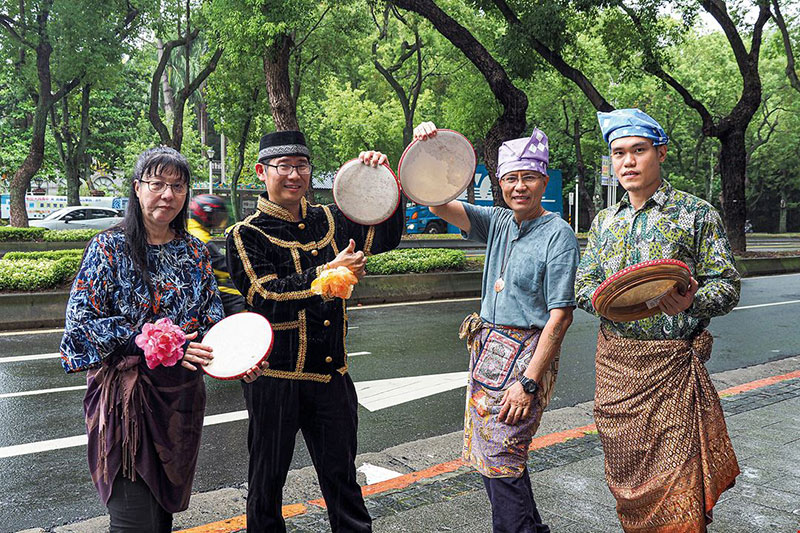
Ngo Jian Nam (second from left) has formed Tampo, a Malaysian hand drum troupe, with friends. Believing that music can transcend linguistic and national boundaries, they wish to share the beauty of their native country with Taiwanese people. (photo by Jimmy Lin)
Since the launch of Taiwan’s New Southbound Policy, immigrants from Southeast Asia have been enjoying greater job and financial security. However, their quality of life and psychological wellbeing still leave much room for improvement. “This is because we have not been making enough effort to understand the ethnic cultures of Southeast-Asian countries, nor are we all that willing to do so.” Ted Tsai, a professor in the Graduate Institute of Ethnomusicology at Tainan National University of the Arts, thinks that while Taiwan as a whole is tolerant of cultural differences and its people are friendly and warm-hearted, behind this welcoming façade there are things that require careful examination and amelioration.
Tsai’s work on Southeast-Asian ethnic music and performance art has yielded valuable insights into the current conditions of Southeast-Asian immigrants in Taiwan and the predicaments they face in their daily lives. He flags up these issues and invites the Taiwanese people to engage with them.
Art in daily life“In terms of political and economic status, Taiwan resembles the Northeast-Asian countries, but in music, art, and other aspects of culture, it is actually more akin to Southeast Asia,” says Tsai, who has devoted his life to studying ethnic music across the world and is a member of Taiwan’s Southeast Asia Advisory Committee. Advising the Ministry of Culture’s Department of Cultural Exchange on a program of collaborative cultural projects between Taiwan and Southeast Asia, Tsai articulated a conclusion drawn from many years of field research: “For people of Southeast-Asian origin, it’s impossible to separate music or performance art from their daily lives. Their hearts and souls are sustained by them.”
Southeast-Asian ethnic music is an art form that features the intersubjectivity of music, dance, and drama. It allows of freedom and variation, and while it is unique, it also displays salient traits shared by other types of world music and ethnic music. Performance art is an essential part of Southeast-Asian people’s heritage. Both physically and spiritually, it is integral to their existence.
Where is home?“After coming to Taiwan, migrant workers and long-term immigrants turn to the traditional performance arts of their native countries, such as music and dance, in order to alleviate homesickness, preserve their cultures, and reconnect with their languages. In doing so, they’re able to attain a clearer sense of their own identity and express their feelings. They also interact with each other and forge interpersonal connections this way,” Tsai observes. “Without these things, they can’t go on to live a good life, and they may even feel torn from their native cultures.” Those who lack emotional support are likely to lose their sense of purpose and feel disaffected. Tsai has come to realize that performance art is relevant to this serious issue.
In Taiwan the total number of Southeast-Asian migrant workers, long-term immigrants, and their children now exceeds 1 million, equivalent to the population of a major municipality. In 2020 the government organized a conference with a view to gaining a deeper understanding of the experience of immigrants in Taiwan. “Studies to date have shown that there are persistent problems in the implementation of education and government policies. Southeast-Asian performance art has been dismissed as relatively insignificant,” Tsai says. “In fact, only if we help immigrants satisfy their daily needs can we address the fundamental issues and enhance their contribution to Taiwan’s economy and society.”
Between money and cultureTsai thinks that the problems faced by long-term immigrant women in Taiwan mainly arise from their single-minded commitment to their families, which makes them financially dependent. “Even though the government has improved its policies toward immigrants, performance art becomes an unaffordable luxury when you do not have a job or are not financially independent, and when family life occupies most of your time.”
Migrant workers are in an even more difficult situation. As most of them are employed as laborers, rather than as highly skilled workers or intellectuals, they tend to be young people who are physically fit. “They are enthusiastic and passionate about life, but they don’t have much free time, nor do they have any money to spare. What’s more, they’re subject to a lot of restrictions and prejudices, including religious discrimination.” Tsai adds that current policies do not give adequate consideration to migrant workers in Taiwan, who number more than 710,000.
Vietnamese flautist Vu Duy Tuan has been in Taiwan for some five years. Not yet fluent in Chinese, he works for a traditional manufacturing company. In order to send money home, he often works overtime at weekends. As a result, he doesn’t have much time at his disposal. “But we’re able to meet up with friends whenever there’s a day off.” Tuan’s fiancée, Do Thi Kim Vien, works in a different place. They met at a Vietnamese gathering.
Kim Vien has been in Taiwan for a long time, working two shifts a day in the hospitality industry. She cherishes every opportunity to connect with fellow Vietnamese expatriates. “We all work in different cities. To save on travel time and expenses, we usually meet up in public spaces near railway stations. But when people find us chatting, singing or dancing together, they come and ask us to leave.”
Discouraged by this unfriendly treatment, they no longer meet up frequently. To assuage his homesickness, Tuan turned to Vietnamese songs, and later started to play the traditional Vietnamese flute, sao meo, which helped him reacquaint himself with his native culture. Tuan practices hard. The Vietnamese flute band he belongs to has almost 20 members now. “But rarely do more than five or six of us turn up each time.”
If meeting up is difficult, finding a welcoming place for rehearsals is even more of a challenge, so Tuan often has to practice alone after work.
What has been overlooked?“Two years ago, when there was a boom in Southeast-Asian performance art, many immigrants were very excited about being invited to perform by the government,” Tsai says. “They took pains to practice performing the traditional arts of their native countries, hoping to connect with Taiwan this way. However, the performers weren’t paid, they weren’t allowed time for rehearsals, and there were no funds for hiring venues. Needless to say, there wasn’t any regulation protecting their rights.” These harsh realities have hampered the development of Southeast-Asian performance art in Taiwan. Tsai expresses his regret: “Our policies have left much to be desired. They have failed to encourage the growth of invaluable performance arts and ethnic cultures. Collaborative opportunities between Taiwan and these cultures are dwindling accordingly.”
Balinese dancer Koming Somawati started to dance when she was a child. “In Bali, and in Indonesia as a whole, singing, playing musical instruments, and dancing are an integral part of everyday life.”
Prior to moving to Taiwan, Somawati traveled the world with her husband, Made Mantle Hood, an American scholar of world music. Hood got a professorship at Tainan National University of the Arts, where he is now head of the Graduate Institute of Ethnomusicology. Somawati, who can only speak English and her mother tongue, came to Taiwan with her husband. She feels that “Taiwanese people are nice. They’re friendly and welcoming. When they find out I don’t speak Chinese, they try their best to communicate with me in English. My students do this, too.”
A highly skilled dancer, Somawati has a distinguished track record. Committed to the promotion of Balinese dance, she gives classes at universities, runs a workshop, and has put on many dance and theatrical performances. “When my friends and I go to buy groceries, the staff at the shopping malls often talk to me in a friendly way,” Somawati says. “They would commiserate with me on the hard task of taking care of elderly people—because this kind of work doesn’t give you any days off.”
Somawati didn’t understand what that meant until a friend explained to the staff on her behalf: “She’s a professional Balinese dance teacher!” It was only then that Somawati realized that Indonesian women in Taiwan are subjected to certain stereotypes: that they come here either to get married or to work as carers seven days a week.
Ngo Jian Nam, an immigrant who founded Taiwan’s first Malaysian hand drum troupe, and who is currently a presenter at National Education Radio, agrees that we need to reconsider our policies on performance art. “Southeast-Asian music has to be performed by ensembles. But musicians find it difficult to come together because of their jobs and their different immigration statuses.”
“All the members of our hand drum troupe are long-term immigrants, so we have been able to obtain funding from the government’s Dream-Building Program for New Immigrants and Their Children. But to be frank, the application process is very complex, and there are many conditions. Even eligible long-term immigrants may feel deterred, let alone migrant workers who do not qualify for funding under the scheme.” The situation described by Ngo corroborates Ted Tsai’s research findings.
Cultural diversity in Taiwan“Are we ready to provide them with suitable living space and adequate room for their pastimes? Furthermore, have we shown enough respect for their religious beliefs, and have we tried to understand them?” Tsai tells us that performance art remains under the radar of the New Southbound Policy, even though it is of vital importance to the identity-shaping process of Southeast-Asian immigrants in Taiwan, to their children’s reception of their immigrant parents’ native cultures, and to migrant workers’ need to express their feelings in daily life.
“To break this vicious circle, there should be policy reform that takes into account the different needs of different people. In cases such as the vast population of immigrants and migrant workers, we have to consider various factors, from the economy to an individual’s everyday life.” Tsai suggests a possible solution: “Only by addressing these issues in our education and by working to change attitudes can we dispel prejudices and achieve social harmony and unity, turning Taiwan into a wonderful place that genuinely embraces cultural diversity.”